What GHK-Cu is and what "copper peptide" means
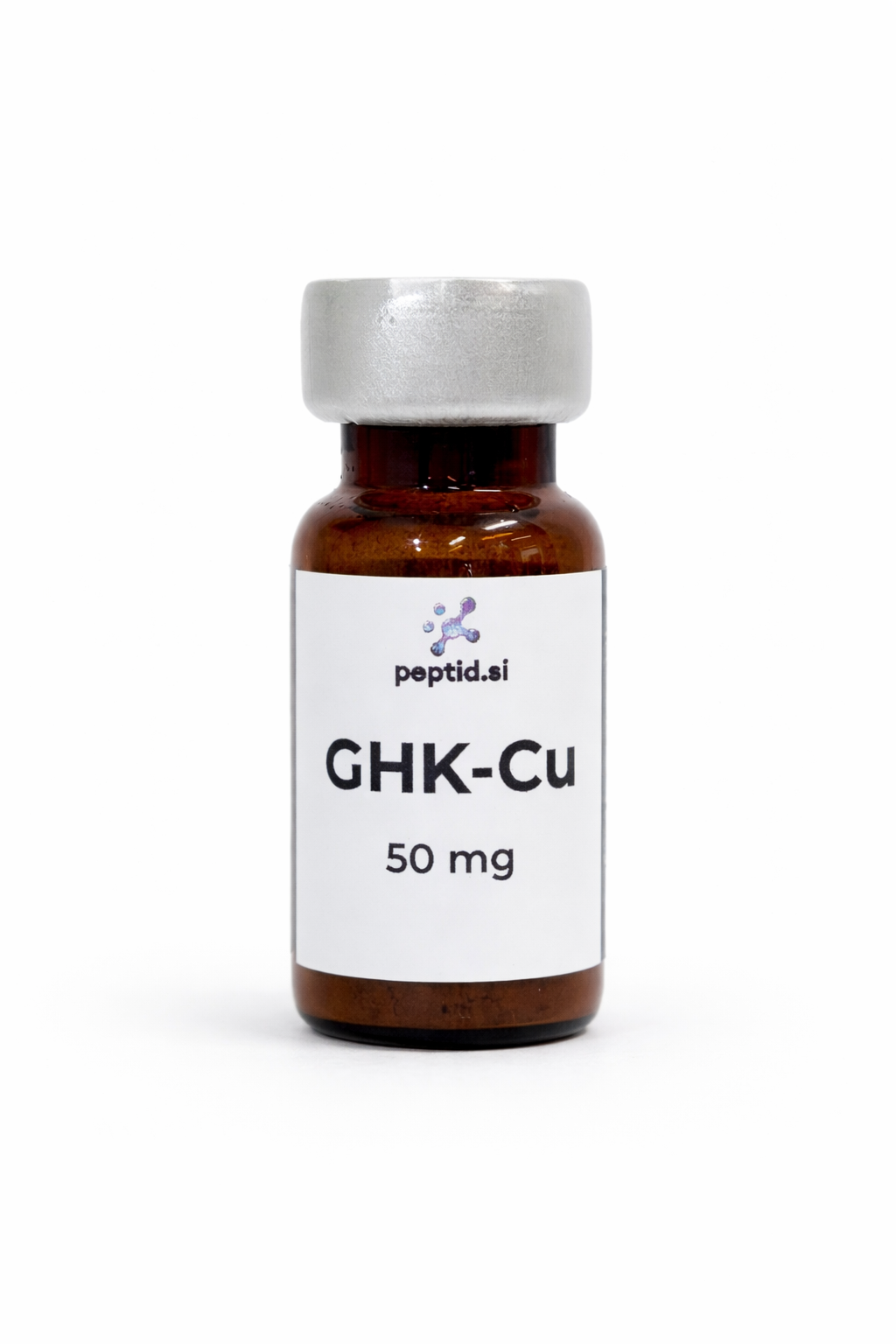
GHK is a tripeptide of glycine, histidine and lysine (Gly-His-Lys). The arrangement of its atoms lets it bind a copper(II) ion strongly; the complex of peptide and copper is called GHK-Cu, or copper peptide, and in Slovenian bakrov or bakreni peptid. All of these names mean the same compound. GHK was first described as a component of human plasma; today laboratories make it synthetically. The essential distinction is between copper-free GHK, a colourless peptide, and GHK-Cu, a blue complex. Because price and research use differ, the label and the COA must state clearly which form you bought.
Which research GHK-Cu appears in
The 2018 review by Pickart and Margolina summarises data from cell cultures, tissue samples, animal models and gene-expression analyses in which researchers studied how GHK-Cu influences gene expression and the synthesis of extracellular matrix components such as collagen. An earlier 2015 review focuses on cellular pathways in models of skin regeneration. How you read these findings matters: they are results in cells and models that describe mechanisms, not evidence of effects in people. That is exactly why GHK-Cu is interesting as a research reagent for in vitro work, for example in fibroblast studies, and not as a product for use on skin or in the body. We covered the individual studies and their limits in our GHK-Cu overview article.
Why the powder is blue and what that tells you
A copper ion bound in the peptide complex absorbs light in the red part of the spectrum, so lyophilised GHK-Cu is bluish to violet. This is an expected property of the compound and, at the same time, the simplest visual check on arrival: a white or greyish powder under a GHK-Cu label is a warning sign, because it suggests either copper-free GHK or a different substance. Colour alone is of course no proof of quality; the COA with measured purity and mass confirms that. After reconstitution the solution is also blue. If it is cloudy, contains particles or turns brown, that indicates degradation or contamination, and the material should not be used in an experiment.
What the COA for GHK-Cu must state
The certificate of analysis for a batch must state the full name and form of the compound (GHK-Cu, the copper complex), a batch number matching the label, purity by HPLC (at least 98% on peptid.si), confirmation of identity by mass spectrometry, and the date of analysis. For GHK-Cu it also helps to check whether the COA distinguishes the mass of the free peptide from the mass of the complex, because the two differ and affect the concentration calculation at reconstitution. Even for such a small molecule the rule from peptide analytics holds: HPLC tells you how pure it is, MS tells you what is in the vial. Together they detect impurities that either method alone would miss.
Price, packaging and comparing suppliers
On peptid.si, 50 mg of lyophilised GHK-Cu costs 74.09 EUR, including the batch COA and dispatch from Slovenia, free above 150 EUR. When comparing suppliers, compare the price per milligram of the same form (GHK-Cu, not GHK) and check whether the COA is public and tied to a batch, whether the analytical method is stated, and whether the supplier lists company details at all. A 2024 study of peptide products bought from online sellers showed that with anonymous vendors the gap between label and content can be enormous. A suspiciously low price, a COA without a batch number and a description promising effects on skin or hair are three warning signs that usually appear together.
GHK-Cu is not a cosmetic and not a medicine
In cosmetics, copper peptides appear as ingredients of registered products that have passed a safety assessment for application to skin. Lyophilised GHK-Cu in a vial is not such a product: it is a research reagent that has been assessed neither as a cosmetic nor as a medicine and is not intended for application to skin, ingestion or injection. In April 2026 JAZMP warned that peptides sold for human use without authorisation cannot be considered safe or effective. That is why peptid.si gives no instructions for use on skin, does not answer questions about effects, and every buyer confirms the research purpose at checkout. Anyone looking for a skincare product should choose registered cosmetics.
Storage, reconstitution and what to order alongside
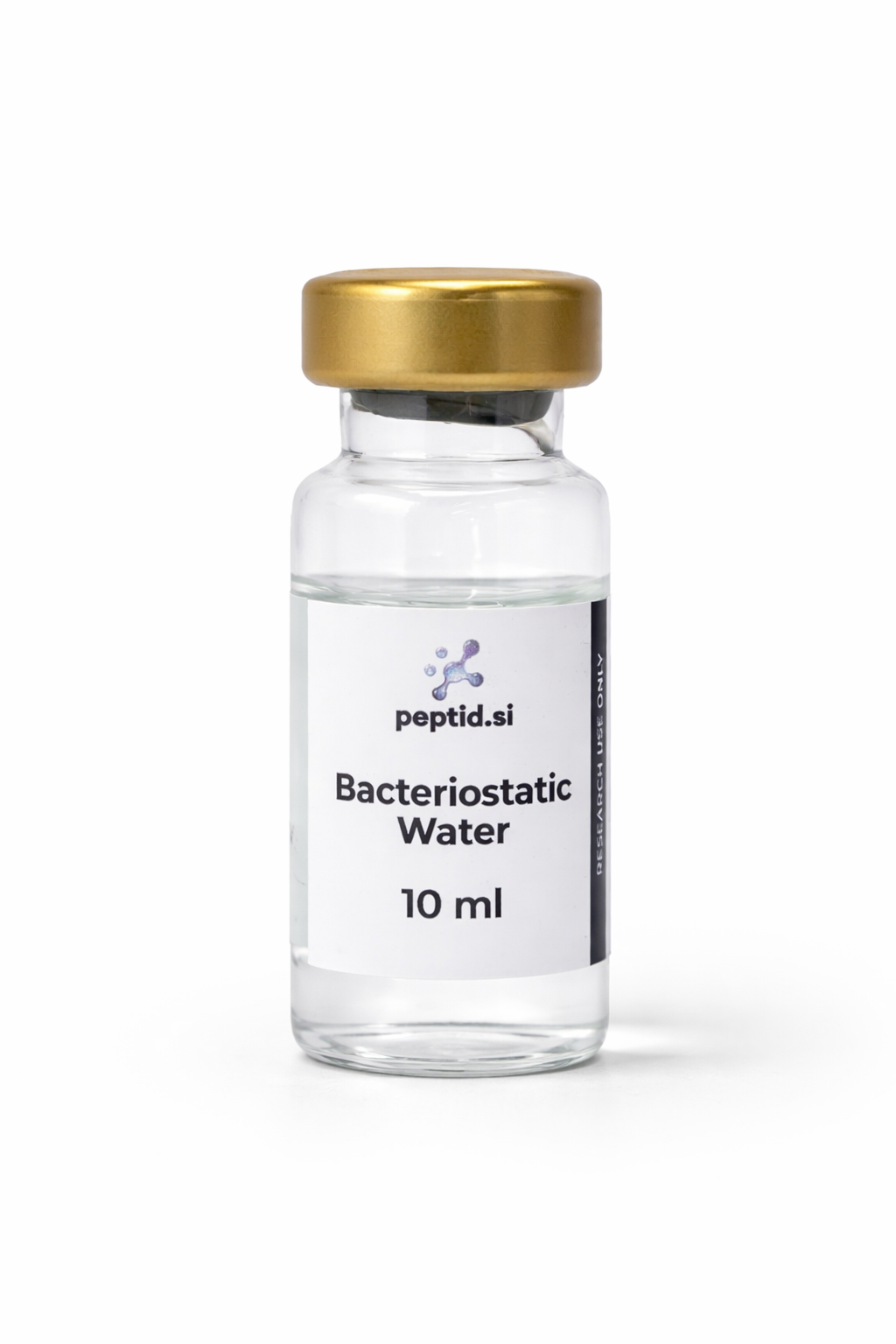
Keep lyophilised GHK-Cu in its closed vial in a refrigerator at 2 to 8 °C, protected from light; in this form it stays stable for months. For in vitro work it is reconstituted with a suitable laboratory solvent, most often bacteriostatic water when you will draw from the vial more than once. Keep the solution refrigerated and use it within the protocol, because it is far less stable than the powder. We described the concentration calculation after reconstitution in a separate article. When ordering GHK-Cu it therefore makes sense to order bacteriostatic water as well, and to check the batch number in the COA Vault before opening the vial.
References / Links
- Pickart L, Margolina A (2018). Regenerative and Protective Actions of the GHK-Cu Peptide in the Light of the New Gene Data. International Journal of Molecular Sciences. PubMed
- Pickart L, Vasquez-Soltero JM, Margolina A (2015). GHK Peptide as a Natural Modulator of Multiple Cellular Pathways in Skin Regeneration. BioMed Research International. PubMed
- Zeng K, Geerlof-Vidavisky I, Gucinski A, et al. (2015). Liquid Chromatography-High Resolution Mass Spectrometry for Peptide Drug Quality Control. The AAPS Journal. PubMed
- Ashraf AR, Mackey TK, Vida RG, et al. (2024). Multifactor Quality and Safety Analysis of Semaglutide Products Sold by Online Sellers Without a Prescription. Journal of Medical Internet Research. PubMed
- JAZMP (Agency for Medicinal Products and Medical Devices of the Republic of Slovenia) (2026). Opozorilo glede uporabe peptidov za injiciranje (Warning on the use of injectable peptides). JAZMP, official notice. Web