What reconstitution is and why it matters
Reconstitution means dissolving lyophilized (freeze-dried) peptide powder in an appropriate solvent to create a solution of known concentration for laboratory work. Peptides are supplied as powder because they are far more stable in the dry state than in solution. The powder is often hygroscopic, so let the vial warm to room temperature before opening to prevent moisture condensing inside it. Add the solvent slowly down the vial wall and swirl the contents gently, never shaking vigorously, because shear forces and foaming accelerate aggregation and denaturation. The goal is a clear, fully dissolved and reproducible stock solution that serves as the starting point for downstream in vitro experiments.
Calculating mass concentration (mg/mL)
Mass concentration is the most basic calculation and follows a simple equation: concentration (mg/mL) = mass of peptide (mg) / volume of solvent (mL). If you reconstitute a vial containing 10 mg of peptide with 2 mL of solvent, you obtain 10 / 2 = 5 mg/mL. For accuracy, measure the solvent volume with a calibrated pipette and use the actual (net) peptide content stated on the certificate of analysis (COA). A lyophilized powder often also contains residual salts and bound water that add to the total mass but not to the true amount of peptide. Using net peptide content rather than gross mass matters especially for the subsequent molar concentration calculation.
Converting to molar concentration
In vitro experiments (e.g. binding assays, EC50 or IC50 determination) often require molar concentration, because it reflects the number of molecules in solution. The conversion needs the peptide's molecular weight (g/mol), given on the data sheet. The equation: molarity (mol/L) = mass concentration (g/L) / molecular weight (g/mol). Since 1 mg/mL equals 1 g/L, a 5 mg/mL solution of a peptide with a molecular weight of 1000 g/mol converts as follows: 5 / 1000 = 0.005 mol/L = 5 mM = 5000 µM. To prepare working dilutions from the stock, apply the rule C1 × V1 = C2 × V2, which lets you accurately reach the target concentrations for your experiments.
Choosing a solvent in an in vitro context
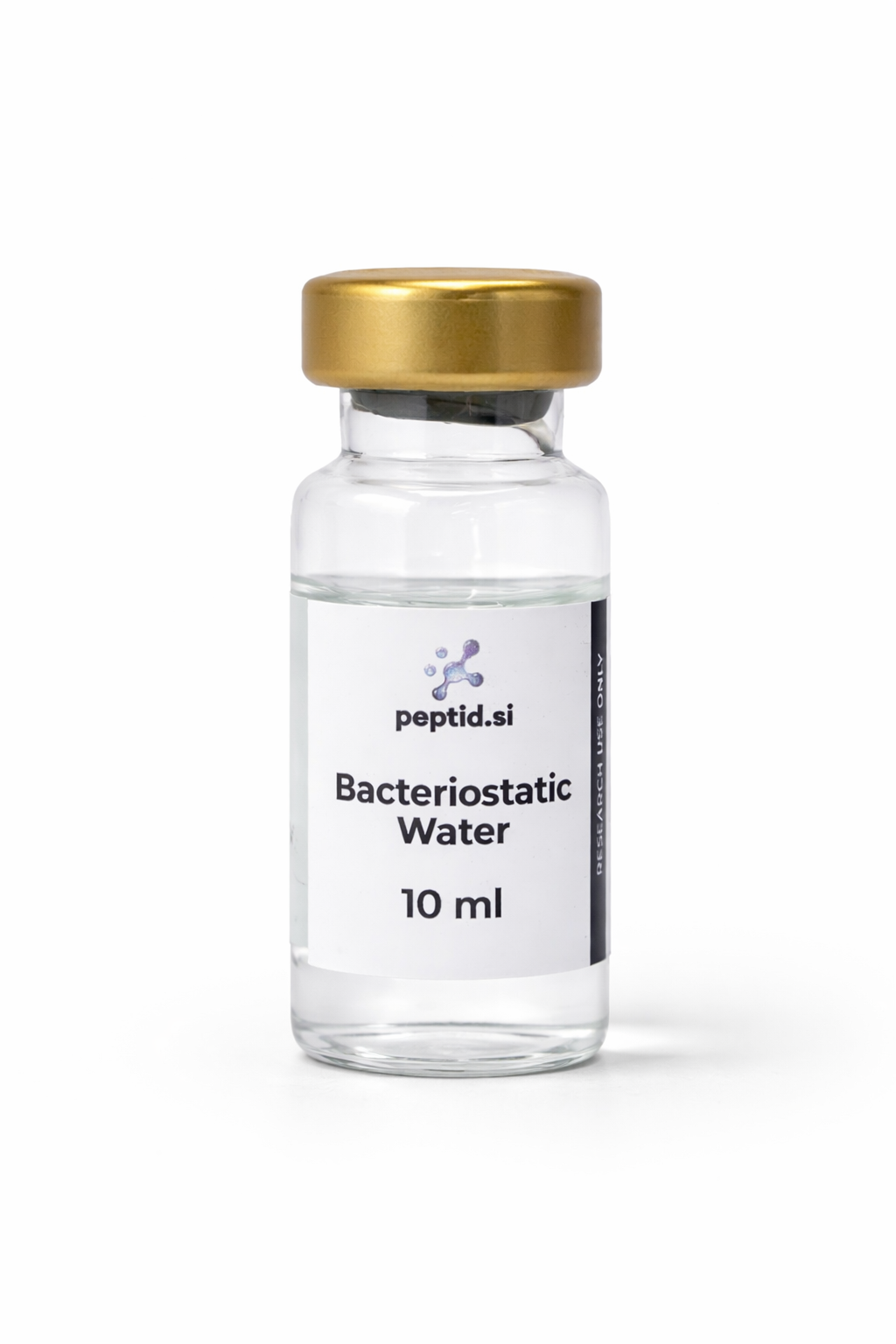
Solvent choice depends on solubility and the purpose of the experiment. Sterile water is a neutral solvent for single-use preparation, while bacteriostatic water (with 0.9% benzyl alcohol) inhibits microbial growth and suits situations where a multi-use vial stock is accessed repeatedly over an extended period. Some peptides dissolve poorly in plain water and require a buffer (e.g. PBS) or a small fraction of a co-solvent; pH significantly affects both solubility and stability. It is worth knowing that benzyl alcohol can promote aggregation of some proteins, so a preservative makes sense only when microbial protection is genuinely needed. Bacteriostatic water for laboratory reconstitution is also available in the peptid.si range.
Storage and avoiding freeze-thaw cycles
Peptides are considerably less stable in solution than as lyophilized powder, so a reconstituted solution has a limited shelf life. The main degradation pathways are hydrolysis, oxidation (particularly at methionine and cysteine residues), deamidation and aggregation; heat, light and oxygen accelerate them. Keep the solution cold and protected from light. It is essential to divide it into single-use aliquots so that each sample is thawed only once. Repeated freeze-thaw cycles cause denaturation at the ice-water interface, cryoconcentration and pH shifts, which lead to aggregation and loss of integrity. Store a short-term working solution in the refrigerator and freeze aliquots for longer periods; discard any solution that becomes cloudy or shows precipitate.
Research use and quality assurance
All peptides and the content of this article are intended strictly for research purposes (Research Use Only). The products are not intended for human or veterinary use, diagnostics or therapy; the calculations described serve to prepare stock solutions for in vitro laboratory experiments and do not constitute medical advice. Reliable results begin with verified purity of the starting material, because impurities and inaccurate peptide content directly distort the concentration calculation. Peptid.si provides laboratory-verified purity for every batch and a publicly accessible certificate of analysis (COA) in its COA Vault, enabling traceability and reproducibility for your research.
References / Links
- Nugrahadi P.P., Hinrichs W.L.J., Frijlink H.W., et al. (2023). Designing Formulation Strategies for Enhanced Stability of Therapeutic Peptides in Aqueous Solutions: A Review. Pharmaceutics. MDPI
- Bak A., Leung D., Barrett S.E., et al. (2014). Physicochemical and Formulation Developability Assessment for Therapeutic Peptide Delivery—A Primer. The AAPS Journal. SpringerLink
- Roy S., Jung R., Kerwin B.A., Randolph T.W., Carpenter J.F. (2005). Effects of benzyl alcohol on aggregation of recombinant human interleukin-1-receptor antagonist in reconstituted lyophilized formulations. Journal of Pharmaceutical Sciences. PubMed
- Hauptmann A., Podgoršek K., Kuzman D., et al. (2018). Impact of Buffer, Protein Concentration and Sucrose Addition on the Aggregation and Particle Formation during Freezing and Thawing. Pharmaceutical Research. SpringerLink