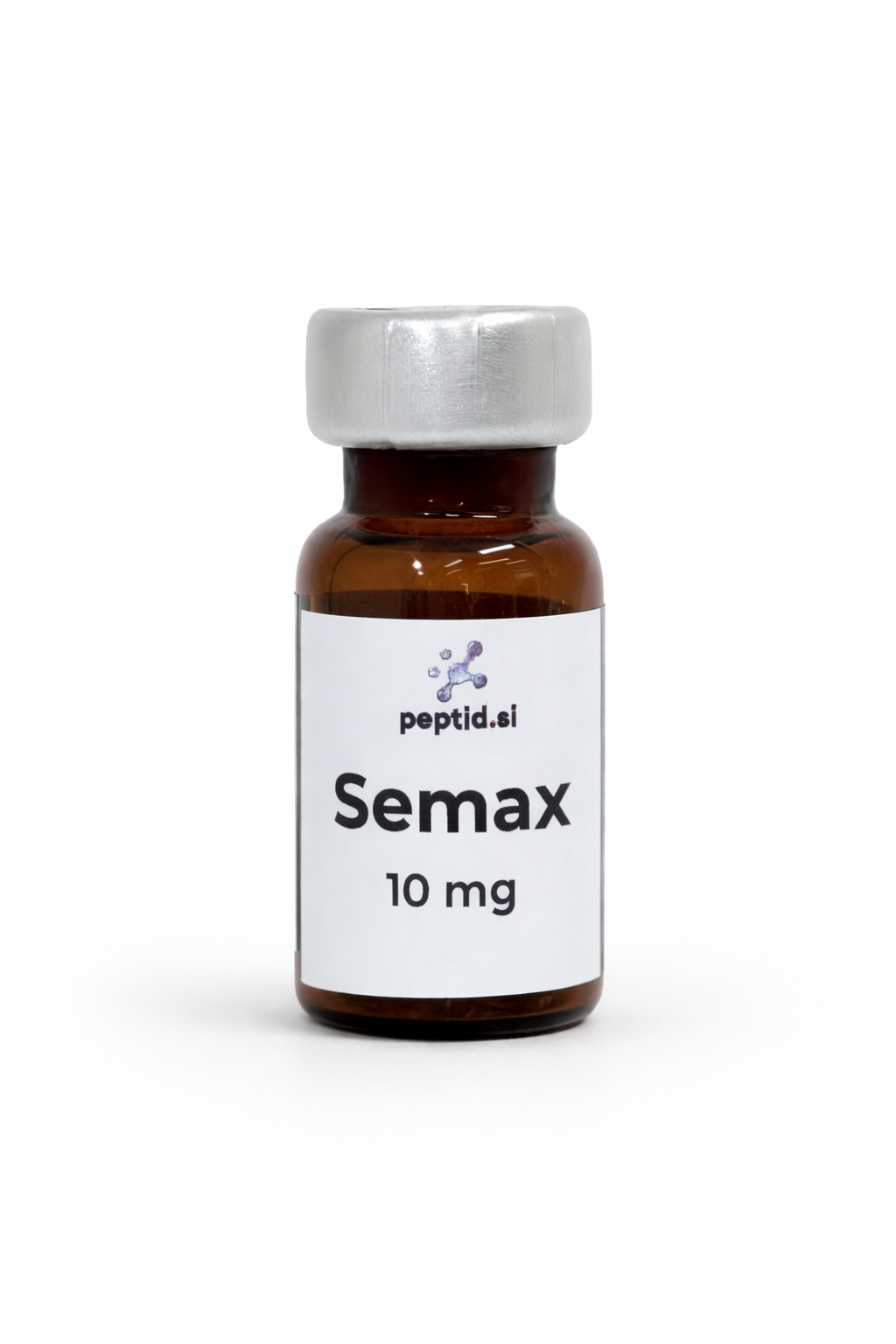
What is Semax and where does it come from?
Semax consists of seven amino acids in the sequence Met-Glu-His-Phe-Pro-Gly-Pro (MEHFPGP). Its molecular weight is about 813.9 Da and its CAS number is 80714-61-0. It is built from the active ACTH(4-7) fragment with an added Pro-Gly-Pro stabilizing tail that extends the peptide's stability in the body. That fragment choice is also why, in preclinical models, Semax lacks the hormonal activity of full ACTH. It has been in research and clinical use in Russia since the early 1990s.
Mechanisms of action
In preclinical models, Semax promotes transcription of the neurotrophic factors BDNF and NGF and their receptors (TrkA, TrkB, TrkC) in brain tissue. After intranasal administration in rats, it raises BDNF levels in the basal forebrain within a few hours. It also modulates expression of immune- and vascular-system genes after ischemia, influences intracellular calcium homeostasis, and stimulates choline acetyltransferase activity. Melanocortin-receptor antagonist properties have also been described.
Preclinical research (animal models)
Most data comes from animal studies. In cerebral ischemia (a rat permanent middle cerebral artery occlusion model), Semax reduced neurological deficits and lowered nitric oxide production in the cortex. Other studies report improved learning and memory, anxiolytic and antidepressant effects with chronic administration, and analgesic effects (via the intraperitoneal route). For nootropic effects, the intranasal route proved more effective than systemic administration.
Human clinical research
Several clinical studies in Russia in patients with acute ischemic stroke report improved functional recovery, elevated plasma BDNF, and faster improvement in the Barthel index. In healthy volunteers, intranasal Semax improved memory and attention in small studies, and fMRI imaging showed a greater volume of the default mode network. An important limitation: there are no large, double-blind, placebo-controlled randomized trials in the Western peer-reviewed literature.
Regulatory status, safety, and quality
In Russia and Ukraine, Semax is an approved prescription medication and appears on the Russian list of vital and essential drugs. The FDA and EMA have not approved it; the FDA lists it on the 503A list (category 2). The most commonly reported effects are transient discoloration of the nasal mucosa and elevated blood glucose in diabetic patients; long-term safety data outside Russian-language literature is limited. Semax remains a research peptide (RUO) and is not approved for medical use outside the countries noted above. Peptid.si supplies Semax with laboratory-verified purity, and the COA is publicly available in the COA Vault.
References / Links
- Medvedeva EV, Dmitrieva VG, Povarova OV, et al. (2014). The peptide semax affects the expression of genes related to the immune and vascular systems in rat brain focal ischemia: genome-wide transcriptional analysis. BMC Genomics. PubMed
- Dmitrieva VG, Povarova OV, Skvortsova VI, et al. (2009). Semax and Pro-Gly-Pro activate the transcription of neurotrophins and their receptor genes after cerebral ischemia. Cell Mol Neurobiol. PubMed
- Gusev EI, Martynov MY, Kostenko EV, et al. (2018). Effects of Semax on the default mode network of the brain. Bull Exp Biol Med. PubMed
- Asonova SN, Nalivayeva NN, Sazonova OI, et al. (2006). Semax, an analogue of adrenocorticotropin (4-10), is a potential agent for the treatment of attention-deficit hyperactivity disorder and Rett syndrome. Prog Neuropsychopharmacol Biol Psychiatry. PubMed
- Dolotov OV, Karpenko EA, Inozemtseva LS, et al. (2006). Semax, an analog of ACTH(4-10) with cognitive effects, regulates BDNF and trkB expression in the rat hippocampus. J Neurochem. Wiley
- Skvortsova VI, Stakhovskaya LV, Gubsky LV, et al. (2018). The efficacy of semax in the treatment of patients at different stages of ischemic stroke. Zh Nevrol Psikhiatr Im S S Korsakova. PubMed
- Volchek VV, Goncharov NV, Myasoedov NF, et al. (2001). Effectiveness of semax in acute period of hemispheric ischemic stroke. Zh Nevrol Psikhiatr Im S S Korsakova. PubMed
- Samotrueva MA, Bashkatova VG, Pozdnev VF, et al. (1999). Mechanisms of the neuroprotective effect of semax in the acute period of ischemic stroke. Zh Nevrol Psikhiatr Im S S Korsakova. PubMed
- Manchenko DM, Glazova MV, Levitskaya NG, et al. (2010). Nootropic and analgesic effects of Semax following different routes of administration. Ross Fiziol Zh Im I M Sechenova. PubMed
- Samonina GE, Ashmarin IP, Lyapina LA (2015). Semax, an ACTH4-10 peptide analog with high affinity for copper(II) ion and protective ability against metal induced cell toxicity. Biometals. PubMed
- Shilov ES, Rozhkova ZZ, Silachev DN, et al. (2020). Novel Insights into the Protective Properties of ACTH(4-7)PGP (Semax) Peptide at the Transcriptome Level Following Cerebral Ischaemia-Reperfusion in Rats. Genes. MDPI