What bacteriostatic water is
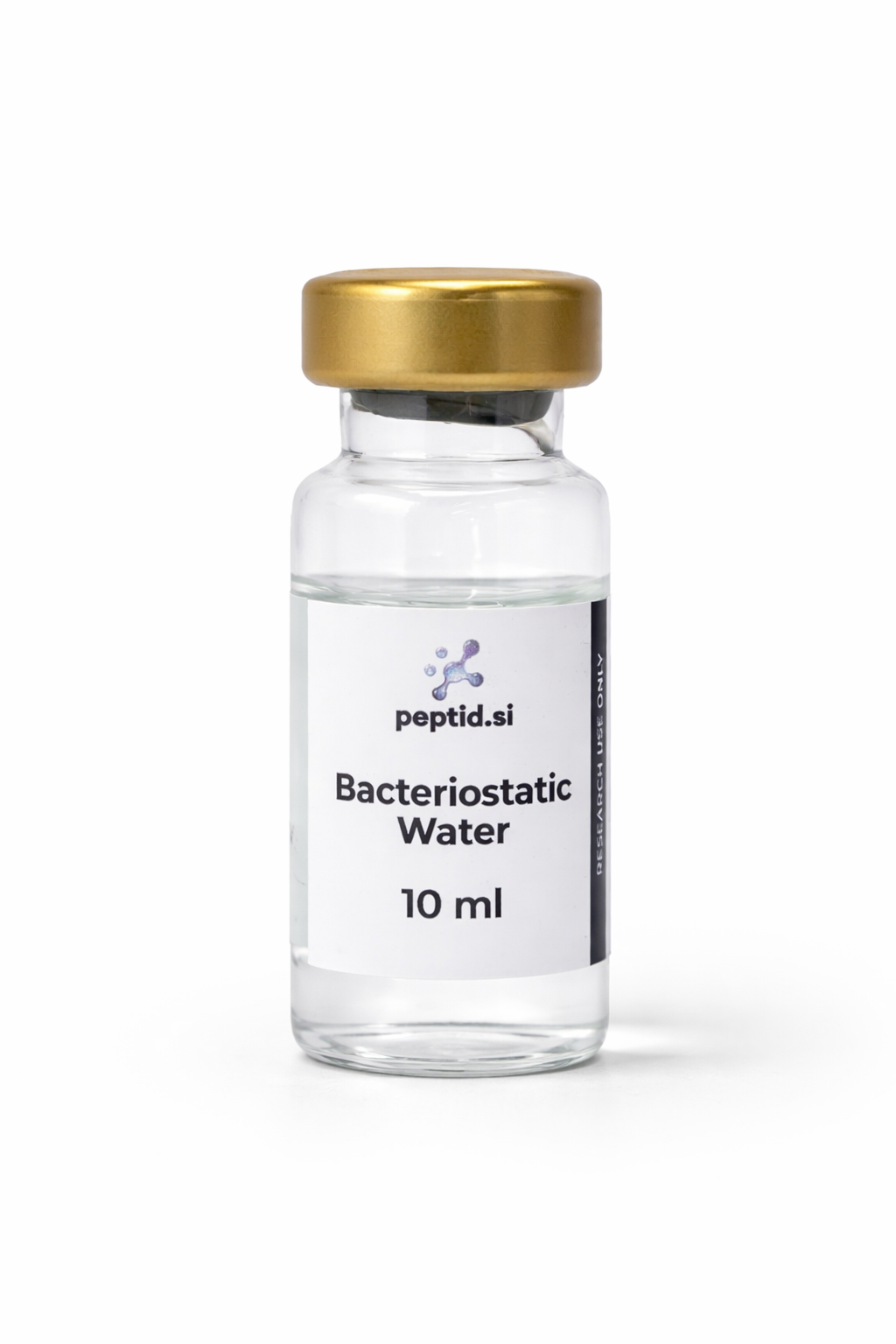
Bacteriostatic water is sterile, non-pyrogenic water to which 0.9% (9 mg/mL) benzyl alcohol has been added as a bacteriostatic preservative. The word "bacteriostatic" means the substance inhibits the growth and reproduction of bacteria rather than necessarily killing them outright. It is precisely this added benzyl alcohol that distinguishes it from plain sterile water, which contains no preservative. In the lab it serves as a solvent for reconstituting lyophilized (freeze-dried) research peptides, because the preservative suppresses microbial contamination during handling. The 0.9% composition is standardized and well documented in pharmacopeial sources, providing reproducible baseline conditions for in vitro work. A 1.1% benzyl alcohol variant also exists, but 0.9% is the most common reference.
Mechanism: how benzyl alcohol inhibits bacteria
Benzyl alcohol acts as a membrane-active compound. Research shows it increases the fluidity of the bacterial cell membrane and reduces its structural stability, which disrupts normal cell function. It also inactivates certain membrane proteins, including the efflux pumps bacteria use to expel harmful substances; once these pumps are disabled, substances accumulate inside the cell and the bacterium becomes more vulnerable. These effects have been demonstrated in vitro — on bacterial samples and artificial membrane vesicles. Importantly, efficacy is pH-dependent (best in the acidic range), and benzyl alcohol acts mainly on vegetative bacteria rather than spores. It is therefore an inhibitory rather than a fully sterilizing effect.
Why the preservative allows multiple withdrawals from a vial
In research work, a reconstituted peptide often needs to be withdrawn in several steps as smaller aliquots for analyses, for example for mass spectrometry or in vitro assays. Each entry of a needle through the stopper is a potential route for introducing microorganisms. The bacteriostatic preservative inhibits the growth of any contaminants introduced during repeated punctures, so the reconstituted vial remains usable longer and permits several successive withdrawals. Review articles on preservatives for protein and peptide formulations cite this as the primary reason for using preserved water in multi-dose vials. Plain sterile water lacks this property and is intended for single use. Aseptic technique remains essential — the preservative is a complement to, not a substitute for, proper handling and storage.
The difference between bacteriostatic and plain sterile water
Both types of water are sterile and non-pyrogenic; the key difference is the preservative. Sterile water contains no benzyl alcohol or other additives, so once opened it cannot hold back the growth of contaminants and is intended for single use. Bacteriostatic water with 0.9% benzyl alcohol, by contrast, permits multiple withdrawals from the same reconstituted vial. The choice between them depends on the research protocol: when several successive aliquots are needed, preserved water is more practical; when the preservative could interfere with a sensitive assay (for example some cell cultures or analyses where benzyl alcohol affects the result), preservative-free water is preferred. Knowing the solvent's composition is essential, because it can affect peptide stability and the validity of analytical results.
Why tap, bottled, or distilled water is unsuitable
For controlled laboratory work, ordinary water is inadequate. Tap and bottled water contain dissolved minerals, chlorine, microorganisms, and other impurities that can react with the research compound or distort analytical results. Distilled water removes most minerals but is not necessarily sterile or non-pyrogenic — it may contain bacteria or their breakdown products (pyrogens, i.e. endotoxins). None of these is standardized for composition, pH, or absence of particulates, which is decisive for reproducible research. Bacteriostatic and sterile water for laboratory use are manufactured to pharmacopeial standards, are non-pyrogenic, and have a documented composition, so they provide reproducible baseline conditions. Using non-standardized water introduces uncontrolled variables that can invalidate an experiment.
Quality and research-use-only status (RUO)
All products at peptid.si are intended exclusively for research use (Research Use Only) and are not intended for use in humans or in veterinary medicine; nor are they a medicine. This article is educational and is not medical advice. peptid.si offers 3 mL of bacteriostatic water, included free with orders, so you have a suitable standardized reconstitution solvent on hand. Every batch of research peptides is laboratory-verified for purity — using methods such as liquid chromatography (HPLC) and mass spectrometry — and a public certificate of analysis (COA) for each batch is available in the COA Vault. This lets researchers verify the identity, purity, and quality of the material before work begins.
References / Links
- Stroppel L, Schultz-Fademrecht T, Cebulla M, Blech M (2023). Antimicrobial Preservatives for Protein and Peptide Formulations: An Overview. Pharmaceutics (MDPI). PubMed
- Yano T, Miyahara Y, Morii N, Okano T, et al. (2016). Pentanol and Benzyl Alcohol Attack Bacterial Surface Structures Differently. Applied and Environmental Microbiology (ASM). PubMed
- Hospira, Inc. (FDA label, DailyMed) (2019). Bacteriostatic Water for Injection, USP — Prescribing Information / Label. DailyMed, U.S. National Library of Medicine. Web